

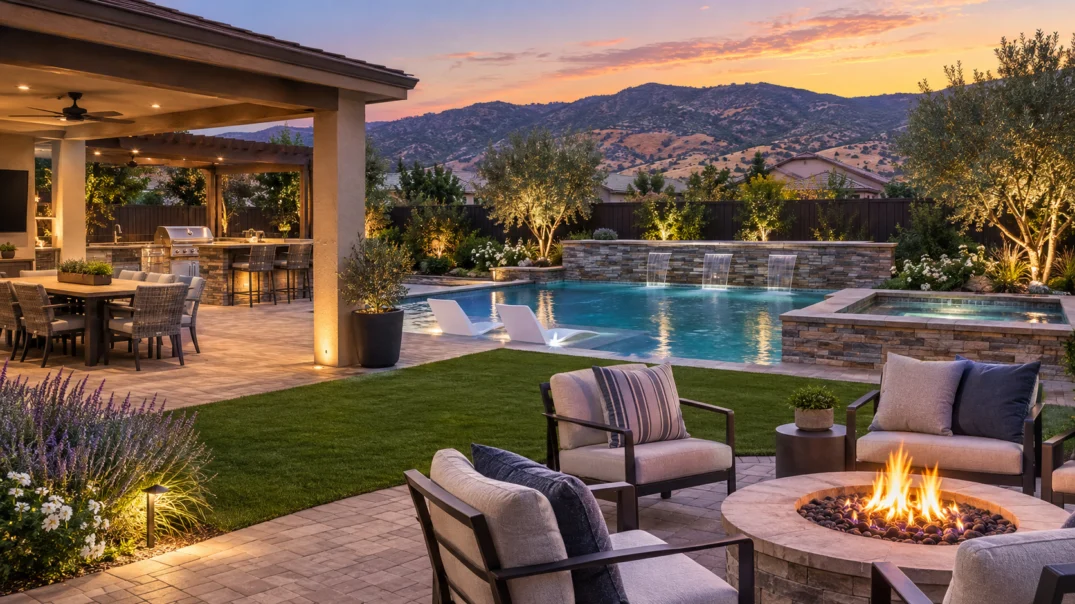
Porterville occupies a unique place in Tulare County.
Set near the eastern edge of California’s San Joaquin Valley, Porterville sits where the broad agricultural landscape begins transitioning toward the Sierra Nevada foothills. Travel east from town and the scenery changes quickly as you approach the Tule River, Lake Success, Springville, and the mountains beyond.
That setting gives Porterville a landscape identity that is distinctly its own.
There are established neighborhoods with mature trees and older homes, newer residential communities offering homeowners an opportunity to create outdoor spaces from the ground up, properties influenced by generations of agriculture, and homes where views toward the foothills can become part of the landscape itself.
For homeowners, all of that provides inspiration.
A Porterville landscape doesn’t have to follow a generic California formula. It can take its cues from the architecture of the home, the surrounding neighborhood, Porterville’s agricultural roots, nearby recreation, the foothills, and most importantly, how the people living there actually want to use their property.
At Terra Landscape Collection, we believe the best landscape designs begin with those relationships.
The goal isn’t simply to landscape a yard.
It’s to create an outdoor environment that feels like it belongs to the home and becomes part of everyday life.
Where the San Joaquin Valley Meets the Sierra Foothills
One of Porterville’s defining characteristics is its location.
West of the city lies the agricultural floor of the San Joaquin Valley. To the east, the terrain begins climbing toward the Sierra Nevada.
That transition can provide a tremendous amount of inspiration for residential landscape design.
Natural stone, substantial trees, layered planting, boulders, ornamental grasses, wood structures, informal pathways, and carefully positioned outdoor gathering areas can introduce some of the character of the surrounding region into a residential property.
That doesn’t mean every Porterville backyard needs to look rustic.
A contemporary home can still draw from the colors, textures, vegetation, and natural materials of the surrounding landscape while maintaining clean architectural lines.
A traditional home may call for something entirely different.
The important thing is that the landscape responds to the property instead of simply reproducing a design that could have been built anywhere.
Let the Surrounding Landscape Become Part of the Design
Sometimes the best landscape feature isn’t inside the property line.
Homes with views toward the eastern foothills can take advantage of those surroundings through careful planning.
A large tree planted in the wrong location could eventually block a view worth preserving.
A patio shifted to another part of the yard might capture a better view.
A fire pit or seating area oriented toward the foothills might create an entirely different experience than one facing a fence or neighboring property.
Landscape design can frame desirable views while screening things homeowners don’t want to see.
Trees, walls, structures, and planting can create privacy in one direction while intentionally leaving another direction open.
This kind of site-specific planning is what makes a landscape feel connected to its location.
Lake Success and the Tule River Are Part of Porterville’s Outdoor Identity
Just east of Porterville, the Tule River and Lake Success have long been connected with recreation and outdoor life in the region.
Families use the area for boating, fishing, camping, picnicking, hiking, and spending time outdoors.
A residential landscape doesn’t need to imitate a lakefront property to take inspiration from that lifestyle.
Natural stone, shaded gathering areas, informal planting, pathways, ornamental grasses, water elements, fire features, and comfortable places to sit can create a more relaxed outdoor environment.
For a family that regularly spends weekends at Lake Success or exploring the foothills, the backyard can become another extension of that outdoor lifestyle.
Instead of designing a yard primarily to be looked at through a window, design it to be lived in.
Porterville’s Agricultural Heritage Can Inspire the Landscape
Porterville developed within one of California’s major agricultural regions.
Citrus, orchards, farming, and ranching remain part of the identity of the surrounding area.
Those influences can translate naturally into residential landscape design.
Citrus trees are an obvious example.
Orange, lemon, mandarin, lime, and other fruit trees don’t have to be hidden behind the garage. They can become intentional parts of the landscape.
A citrus tree can provide greenery, fragrance while flowering, colorful fruit, and something a family can actually harvest.
Several trees might define an edge of the property or create a small backyard orchard.
Combined with herbs, garden beds, trellises, flowering plants, pathways, and outdoor dining areas, these features can create a landscape that feels connected to Porterville and the surrounding Central Valley.
Edible Landscaping Can Be Beautiful
A productive backyard doesn’t have to look like a farm.
Fruit trees can provide structure within planting areas.
Herbs can grow near an outdoor kitchen.
Raised garden beds can become attractive architectural elements.
Grapevines can grow along trellises or overhead structures.
A small orchard can become a destination within a larger property.
Even a few strategically selected edible plants can make the landscape more interactive.
Instead of simply maintaining the backyard, the family can harvest fruit, grow herbs, tend a garden, and experience the landscape changing throughout the seasons.
Established Porterville Neighborhoods Deserve a Different Approach
Not every Porterville landscape starts with a new house and an empty backyard.
The city contains established neighborhoods with mature trees, larger yards, older homes, and landscapes that may have been developing for decades.
These properties require a different design philosophy.
The first question shouldn’t automatically be:
“What can we remove?”
A better question is:
“What is worth keeping?”
A mature tree may already be one of the most valuable landscape features on the property.
Existing walls, walkways, planting areas, garden features, and other elements may also deserve to become part of the new design.
Sometimes completely clearing an older landscape removes the very character that makes the property special.
Landscape Design for Porterville’s Older Homes
Porterville’s established areas also include homes representing earlier periods of the city’s growth.
The landscape surrounding an older home should respond to its architecture.
A Craftsman-influenced house, for example, may pair naturally with broad entry walks, substantial planting beds, natural stone or brick accents, mature-looking trees, and layered greenery.
Another traditional home might call for more formal organization.
A mid-century property may benefit from cleaner lines and a different plant palette.
The house should help guide these decisions.
When the architecture and landscape belong together, the entire property feels more intentional.
New Home Communities Are Changing Porterville
Porterville isn’t only a city of established neighborhoods.
New residential construction continues to add homes and neighborhoods around the community, creating a completely different landscape opportunity.
Communities such as Laurelwood, Brookside, and Villas at Sierra Meadows represent newer residential development in the Porterville market.
For homeowners buying new construction, moving day may mark the completion of the house, but it can be only the beginning of creating the property.
The outdoor environment is where a homeowner has an opportunity to transform a newer house into something much more personal.
Laurelwood: Turning a New Home Into a Complete Property
Laurelwood is one of Porterville’s newer residential communities, offering new single-family homes with a variety of floor plans.
For a homeowner moving into Laurelwood, the backyard may initially be one of the least developed parts of the property.
That’s an opportunity.
Rather than making individual improvements over several years without an overall direction, the entire landscape can be considered from the beginning.
A Laurelwood backyard could eventually include:
- A covered outdoor living area
- A barbecue island or outdoor kitchen
- A swimming pool or spa
- A fire pit or outdoor fireplace
- Lawn for children and pets
- Citrus or other fruit trees
- Garden areas
- Trees positioned for future privacy
- Landscape lighting
- Patios and walkways
- Seating areas
- Outdoor entertainment space
The landscape is one of the easiest ways to give a new home its own personality.
Two similar houses can feel completely different once their landscapes mature.
Brookside: Design for What the Landscape Will Become
Brookside is another Porterville new-home community where homeowners have the opportunity to create an outdoor environment essentially from the beginning.
One of the most important considerations with a new landscape is time.
Trees that are relatively small when installed can eventually become major features.
Planting areas fill in.
Outdoor spaces begin to feel more established.
Privacy changes.
Shade patterns change.
A landscape designed only around what it looks like during the first year can become crowded or poorly organized later.
A better approach is to imagine what the Brookside property should look and feel like five, ten, or even fifteen years from now.
Where will mature trees have the greatest impact?
Which views should remain open?
Where will additional privacy eventually be needed?
Could a future pool change the backyard layout?
Might an outdoor kitchen or patio cover be added later?
Planning for those possibilities early can save homeowners from having to undo previous improvements.
Villas at Sierra Meadows: Connecting New Homes With the Foothills
Villas at Sierra Meadows presents another interesting opportunity for Porterville landscape design because of the community’s relationship with the nearby Sierra Nevada foothills.
A newer home doesn’t have to feel disconnected from its surroundings.
Natural materials, trees, stonework, layered planting, and outdoor gathering areas can help establish a stronger relationship between newer architecture and the surrounding Porterville landscape.
Views can also become part of the design.
If a property has an attractive outlook toward the foothills, a patio, seating area, fire feature, or other outdoor destination can be positioned to take advantage of it.
As trees and planting mature, the landscape can soften the appearance of newer construction and give the property a more established character.
Buying a New Porterville Home? Plan the Backyard Early
Homeowners purchasing in Laurelwood, Brookside, Villas at Sierra Meadows, or other new Porterville neighborhoods have an advantage that isn’t always available when renovating an established property.
They can plan before years of additions accumulate.
That opportunity is worth taking seriously.
Before pouring a large patio, consider whether a future swimming pool could change its location.
Before planting trees, determine where privacy and shade will eventually be most valuable.
Before installing an outdoor kitchen, consider its relationship to the indoor kitchen, dining areas, gathering spaces, and pool.
Before installing permanent hardscape, think about drainage, irrigation, utilities, lighting, future structures, and access.
The entire project doesn’t necessarily have to be constructed at once.
A complete landscape design can act as a roadmap, allowing the property to be developed intelligently in phases.
From Builder Backyard to Custom Outdoor Environment
A builder creates the house.
The landscape is where homeowners can create much of the personality of the property.
A relatively simple backyard can eventually become a complete outdoor living environment.
One family might center the design around a swimming pool.
Another might prioritize a large outdoor kitchen and covered dining area.
Another may want lawn, fruit trees, raised gardens, and plenty of room for children.
Another may prefer an intimate backyard with a fireplace, seating, planting, and landscape lighting.
There isn’t one correct answer.
The right design depends on the people living there.
Designing Outdoor Spaces Around Real Life
A successful backyard isn’t necessarily the one containing the most features.
It’s the one people actually use.
Before deciding what should be installed, think about what happens at home.
Does the family entertain frequently?
Are there children or grandchildren?
Are there pets?
Does someone love cooking?
Would a pool be used regularly?
Is gardening important?
Does the family host large gatherings?
Would a quiet place for morning coffee get more use than another large entertainment area?
These questions often provide more useful design direction than simply looking through photographs of other people’s backyards.
Create Outdoor Rooms
One of the best ways to make a larger property more interesting is to create multiple outdoor destinations.
Think of the backyard as a collection of outdoor rooms.
The patio closest to the house might serve as the everyday dining area.
An outdoor kitchen could become the entertaining center.
A swimming pool could create another destination.
A fire pit farther into the yard could provide a gathering place in the evening.
A garden or small citrus orchard might occupy another area.
A seating space beneath trees could become a quieter retreat.
Paths, planting, lighting, walls, and changes in materials can connect those spaces.
The backyard becomes something to move through and experience rather than one large open area.
Outdoor Kitchens That Actually Work
Outdoor kitchens are increasingly popular because they can change how families entertain.
But size isn’t everything.
For some Porterville homeowners, a well-designed barbecue island with preparation space, storage, and seating may be all that’s needed.
Other properties may call for a more complete outdoor kitchen incorporating refrigeration, sinks, burners, pizza ovens, televisions, bar seating, and substantial preparation areas.
What’s important is the relationship between the outdoor kitchen and everything around it.
It should connect logically with the indoor kitchen.
The cook should still feel connected with guests.
Traffic to the pool shouldn’t constantly pass through the cooking area.
Dining should be nearby.
Good landscape planning solves those relationships before construction begins.
Pools Should Feel Like Part of the Landscape
A swimming pool can become the centerpiece of a Porterville backyard, but the pool itself is only one component.
The surrounding landscape determines how the entire environment feels.
Planting can soften walls and fences.
Trees can create scale and privacy.
A covered patio can connect the house with the pool.
An outdoor kitchen can turn the pool area into a larger entertainment destination.
A spa or fire feature can extend how the area is used beyond swimming.
Lighting can completely change its appearance after sunset.
When all of these elements are planned together, the pool becomes part of the landscape rather than an object placed in the middle of it.
Outdoor Structures Can Extend the House
Pergolas, pavilions, patio covers, and other outdoor structures can become major architectural elements.
A well-designed covered area can function almost like another room.
It might contain an outdoor kitchen, dining table, fireplace, television, lounge furniture, or a combination of these features.
The transition from the interior of the home to the outdoor space is especially important.
When flooring, materials, sightlines, and circulation work together, the outdoor area can feel like a natural continuation of the house.
Fire Features Create Evening Destinations
A fire feature can give people a reason to use another part of the backyard.
That might be a traditional fire pit surrounded by chairs.
It could be a contemporary linear fire feature.
It might be an outdoor fireplace integrated into a covered living space.
Location changes the experience.
A fire pit positioned away from the main patio can become a destination of its own.
People leave the house, walk through the landscape, and gather somewhere different.
That makes the entire property feel larger and more interesting.
Landscape Lighting Creates a Different Property at Night
A good landscape shouldn’t disappear after sunset.
Lighting can reveal an entirely different version of the property.
Trees can be illuminated from below.
Paths can be subtly defined.
Stone and textured walls can become more dramatic.
Outdoor kitchens remain functional.
Pools and water features become visual focal points.
Architectural features can be highlighted.
The objective isn’t to make the property extremely bright.
Good landscape lighting creates layers, contrast, visibility, and atmosphere.
Don’t Forget the Front Yard
Landscape investment often focuses heavily on the backyard, but the front landscape determines how people experience the property every day.
A well-designed Porterville front yard can frame the home, establish the entrance, provide privacy where needed, and give the property its own identity.
On newer streets, trees are particularly important.
As they mature, they can help newer homes and neighborhoods feel more established.
For older Porterville properties, mature trees may already provide that character and should be considered carefully before being removed.
Walkways, planting, lighting, stonework, garden walls, and other architectural elements can then reinforce the design.
Make Side Yards Useful
Side yards are frequently treated as leftover space.
They don’t have to be.
Depending on the property, a side yard can become:
- A garden
- A dog run
- An equipment area
- A pathway connecting front and backyard
- A small orchard
- A utility zone
- A courtyard
- A secondary entrance
- An area for raised garden beds
Planning these spaces as part of the overall landscape prevents them from becoming forgotten strips between the house and fence.
Create Privacy Without Closing Off the Property
Privacy is especially important in newer residential communities where houses and yards may initially feel exposed to neighboring properties.
The answer isn’t always a taller fence.
Trees, layered planting, trellises, outdoor structures, walls, and carefully positioned landscape features can provide selective screening.
The objective is to block unwanted sightlines while preserving views and openness in other directions.
This can make the backyard feel private without making it feel enclosed.
Design a Landscape That Gets Better With Time
Landscapes aren’t static.
Trees grow.
Plants mature.
Materials weather.
Shade patterns change.
Views change.
A well-designed landscape anticipates this.
That is particularly important for new homes in communities such as Laurelwood, Brookside, and Villas at Sierra Meadows, where the surrounding landscape may still be relatively young.
The backyard homeowners see during the first year isn’t what they should expect to see ten years later.
Planning for maturity can produce a landscape that becomes more attractive as the home ages.
Porterville Is More Than One Landscape Style
There isn’t one Porterville landscape style.
That’s a strength.
A home closer to the foothills may take inspiration from natural materials and informal planting.
An established home may call for a traditional landscape that preserves mature trees.
A new home in Laurelwood or Brookside might become a contemporary outdoor entertainment environment.
A Villas at Sierra Meadows property might emphasize foothill views and natural materials.
A larger property could incorporate citrus, gardens, an orchard, a pool, outdoor cooking, and open recreation areas.
The best landscape comes from understanding the individual property rather than trying to force every home into the same design trend.
Landscape Design That Belongs in Porterville
Porterville doesn’t need to look like Palm Springs, Los Angeles, or a generic California subdivision.
It has its own story.
This is a community positioned between the agricultural San Joaquin Valley and the Sierra Nevada foothills.
Its identity includes citrus and agriculture, the Tule River, Lake Success, established neighborhoods, older homes, outdoor recreation, and newer residential communities such as Laurelwood, Brookside, and Villas at Sierra Meadows.
All of those influences can become part of the landscape conversation.
At Terra Landscape Collection, our goal is to bring the architecture, outdoor living spaces, planting, hardscape, lighting, and surrounding environment together into one cohesive design.
That could mean transforming an established Porterville backyard.
It could mean designing an outdoor kitchen and entertaining area.
It could mean creating a complete pool environment.
It could mean planning the landscape for a newly constructed home before the backyard has been developed.
Or it could mean taking a property that has accumulated decades of separate improvements and finally bringing everything together.
Whatever the starting point, the finished landscape should do more than look good in photographs.
It should make people want to go outside and use it.
Discover Landscaping Across Tulare County
Porterville is one part of a much larger landscape story throughout Tulare County.
Visalia has its established neighborhoods, new residential growth, and increasingly sophisticated outdoor living environments.
Tulare has its own neighborhoods and connection to the agricultural Valley.
Exeter is closely associated with citrus and its historic downtown.
Lindsay has a strong agricultural identity.
Springville marks a much more noticeable transition into the foothills.
Three Rivers is shaped by the Kaweah River, surrounding terrain, and its position near the entrance to Sequoia National Park.
Each community deserves its own landscape conversation.
Terra Landscape Collection is exploring these places individually as part of our Tulare County Landscaping Guide, bringing together local communities, landscape ideas, outdoor living inspiration, and real projects from across the region.
Explore the Tulare County Landscaping Guide to discover more landscaping ideas for Porterville, Visalia, Tulare, Exeter, Lindsay, Dinuba, Springville, Three Rivers, and surrounding Tulare County communities.
Planning a Porterville Landscape Project?
Whether you’ve purchased a new home in Laurelwood, Brookside, Villas at Sierra Meadows, or another growing Porterville neighborhood, are renovating an established property, or simply want to rethink the way your family uses the outdoors, the best place to begin is with a plan.
Look beyond individual features and consider the entire property.
Think about where people will gather.
Think about what you’ll see from inside the house.
Consider what the trees will look like years from now.
Decide whether a future pool, outdoor kitchen, garden, patio cover, fire feature, or other improvement should influence decisions being made today.
Most importantly, think about how you actually want to live outside.
Terra Landscape Collection can help turn those ideas into a Porterville landscape designed around your home, your property, and the way you want to live.